September 28, 2026 |The conference is international
DESALINATION OF SEAWATER FOR DRINKING WATER, AGRICULTURE AND ENVIRONMENTAL PROTECTION
The MAS Association for the Environment and Human Rights – MAS Association is pleased to announce the organization of the International Conference on Seawater Desalination, which will be held in Rome from 28 to 30 November 2026.
The conference aims to promote dialogue, cooperation and the exchange of knowledge in the field of sustainable water resource management, with particular attention to innovative technologies for the treatment and desalination of seawater and saline water.
MAIN CONFERENCE THEMES
During the event, several topics of international interest will be addressed, including:
- Desalination and treatment of seawater and saline water.
- Production of safe water intended for human consumption, in compliance with applicable regulations and standards.
- Innovative and sustainable technologies for the treatment of water resources.
- Sustainable use of water in agriculture and reduction of water waste.
- Valorization of salts and residues resulting from treatment processes, for compatible applications and in compliance with the necessary assessments and regulations.
- Environmental protection and conservation of natural resources.
- Promotion of scientific, technical and institutional cooperation among experts, researchers, companies, organizations and stakeholders interested in the water and environmental sectors.
A NEW TECHNOLOGY PRESENTED BY THE MAS ASSOCIATION
During the conference, the MAS Association will present its own new technology for the treatment and desalination of saline water and seawater, illustrating its general principles, treatment process and potential applications in the fields of drinking water, agriculture and environmental protection.
The conference will also represent an important opportunity to promote dialogue and explore possible forms of scientific, technological and project-based cooperation with organizations, institutions, companies and professionals interested in developing sustainable solutions for water resources.
DATE AND VENUE
28–30 November 2026
Conference Center
Via Alibert, 5/A – 00187 Rome
Piazza di Spagna
FROM SEAWATER… TO A BETTER LIFE
The MAS Association promotes a vision based on innovation, cooperation, sustainability and environmental protection, with the aim of contributing to research and the development of new solutions to global water-related challenges.
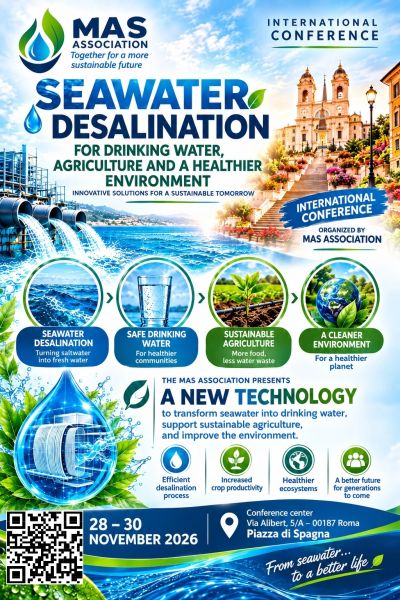
September 23, 2026 | Meeting with the Ambassador of Namibia
MAS Association Delegation in Italy Meets with the Ambassador of the Republic of Namibia in Egypt to Discuss Cooperation in Water, Agriculture and Sustainable Development Projects
A delegation from the MAS Association in Italy, headed by Eng. Ashraf Khalaf, President of the Association, and comprising Dr. Ayman Swidan, First Vice President of the Association and Acting Representative of the Association in Africa, visited the Embassy of the Republic of Namibia in the Arab Republic of Egypt.
The delegation was received by H.E. Ambassador Weich Murcle Uapendura Mupya, Ambassador of the Republic of Namibia to the Arab Republic of Egypt, in the presence of Ms. Irene Simataa, First Secretary of the Diplomatic Mission of the Republic of Namibia in Egypt.
During the meeting, the parties discussed prospects for cooperation between the MAS Association and the governmental authorities and relevant institutions in the Republic of Namibia, as well as the possibility of contributing to the implementation of a number of strategic and development projects, particularly projects related to drinking water, water for agricultural purposes, sustainable development, and environmental protection.
The two sides also discussed the MAS Association's readiness to contribute to coordination with European companies in Italy, Spain and France, as well as Egyptian companies and institutions, with the aim of providing the expertise, technologies and capabilities required to participate in the implementation of strategic projects in the Republic of Namibia.
The delegation of the Association affirmed its commitment to strengthening cooperation with the Republic of Namibia and establishing channels of communication between governmental authorities and specialized companies, in support of projects in the fields of water, agriculture, environment and sustainable development.
The meeting forms part of the efforts of the MAS Association in Italy to strengthen international cooperation and open new avenues for development cooperation with African countries.
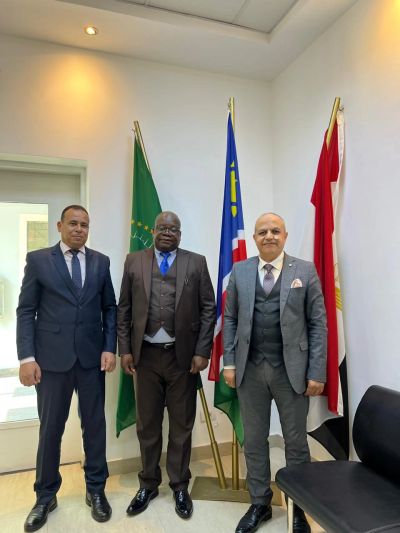
March 2, 2026 | Signing of a protocol with the Mauritanian M
Dr. Ayman Swidan, a member of the Board of Directors of MAS for Human Rights and Environment – Italy, has officially signed a comprehensive Strategic Cooperation Program with the Ministry of Environment and Sustainable Development of the Islamic Republic of Mauritania, marking the beginning of a long-term institutional partnership aimed at strengthening environmental protection, climate action, and sustainable development efforts.
This three-year program, renewable upon mutual agreement, establishes a structured framework for technical and institutional cooperation. It is designed to provide direct support to the Ministry without imposing significant financial burdens, leveraging the Association’s extensive network of international experts, European engineering offices, environmental project implementation companies, and international funding partners.
Key Areas of Cooperation
The program is structured around six integrated strategic pillars:
- Combating Desertification and Land Restoration through afforestation projects using drought-resistant local species and sustainable land rehabilitation techniques.
- Climate Change and Renewable Energy via pilot solar and wind energy projects, climate reporting support, and early warning systems for environmental risks.
- Waste Management and Green Economy by introducing integrated waste sorting, recycling, and valorization models, alongside income-generating green initiatives.
- Coastal Protection and Biodiversity Conservation, including shoreline protection, support for protected areas, and environmental monitoring using modern technologies.
- Capacity Building and Training for national technical staff through workshops, local programs, and training exchanges with European partner institutions.
- Women’s Empowerment in Environmental Development (Urban and Rural) as a cross-cutting priority, strengthening women’s leadership in environmental management and green entrepreneurship.
Financial Advantage and Added Value
The Mass Association for Human Rights and Environment commits to covering the equivalent of 5% of each agreed project’s cost in the form of technical expertise, studies, design, and supervision services. In addition, participating European implementation companies will provide a 5% discount on project values as a direct environmental contribution in the host country.
Expected Outcomes
This strategic cooperation is expected to:
- Accelerate the implementation of priority environmental projects.
- Reduce overall project costs.
- Enhance national technical capacity.
- Strengthen Mauritania’s international profile as a credible partner in environmental and climate initiatives.
Dr. Ayman Swidan emphasized that this partnership represents a practical model of international cooperation built on knowledge transfer, shared responsibility, and long-term sustainability. The Association reaffirms its full commitment to supporting the Ministry throughout the duration of the program and to mobilizing international partners and funding to ensure lasting environmental and institutional impact.
This agreement marks a significant step toward building a resilient and sustainable environmental system that supports national development priorities while protecting natural resources for future generations.

14 January 2026 | Official meeting organized by the LAINA
As part of an official meeting organized by LAINA Association,
Dr. Ayman Swidan met with:
- Mr. Markus Steiner – Swiss Environmental Advisor
- Mr. Lukas Müller – Expert in Sustainability and Environmental Policy
The meeting focused on environmental issues and sustainable development, with particular emphasis on supporting the countries of the Maghreb region in strengthening their environmental systems and enhancing international cooperation in the field of environmental protection and sustainability.
During the meeting, Dr. Ayman Swidan delivered a presentation addressing the environmental framework in the Islamic Republic of Mauritania, highlighting current challenges as well as available opportunities to advance environmental policies and achieve a balanced approach between development objectives and the protection of natural resources.
The participants also commended the prominent role played by H.E. Ms. Massouda Laghdaf, Minister of Environment, acknowledging her concrete efforts and effective institutional work in developing the environmental sector through initiatives and programs that have contributed to improving environmental performance and promoting sustainability.

12 January 2026 | Vienna, Austria
International Conference on Environmental Biotechnology and Sustainable Solutions (ICEBSS)
12 January 2026 | Vienna, Austria
Within the framework of international collaborative efforts to advance environmental action and support the transition toward a green economy, a high-level meeting was convened on the sidelines of the International Conference on Environmental Biotechnology and Sustainable Solutions (ICEBSS). The meeting brought together Eng. Ashraf Mohamed, President of MAS Association, with a distinguished group of international experts specializing in environmental protection and sustainable development, including:
- Mr. Jonathan Robert Thompson – Senior Environmental Policy Advisor
- Dr. William Michael Anderson – Professor of Environmental Biotechnology & Climate Change
- Expert Charlotte William Fletcher – Environmental Consultant & Carbon Reduction Specialist
- Dr. Maria Elisabetta Romano – International Expert in Sustainable Development & Circular Economy
Key Discussion Themes
The meeting addressed several priority issues related to environmental protection and sustainable development, with particular focus on Green Carbon Factory initiatives and their strategic role in reducing harmful emissions, restoring environmental balance, and contributing effectively to climate change mitigation at both regional and international levels.
Participants explored opportunities for collaborative action to support innovative environmental initiatives, while reviewing advanced scientific technologies and practical solutions aimed at reducing carbon footprints, improving the efficiency of natural resource utilization, and promoting environmentally responsible industrial production models. Successful case studies of Green Carbon Factory projects were also presented, demonstrating their positive impact on local economic development, sustainable job creation, and long-term environmental value.
Institutional Cooperation and Regional Support
The discussions further emphasized the importance of supporting the Ministries of Environment in the Islamic Republic of Mauritania and the State of Libya, highlighting the need to strengthen institutional partnerships, facilitate the exchange of technical and scientific expertise, and enhance national capacities in environmental technologies and green economy practices. Participants agreed that such support represents a strategic pathway to enabling relevant authorities to implement effective environmental policies and to develop legislative and regulatory frameworks that encourage responsible investment in green projects.
Community Engagement and Future Actions
Attendees underscored the importance of raising environmental awareness within local communities, strengthening cooperation between the public and private sectors, and fostering environmental innovation in a manner that ensures balanced development and safeguards the rights of future generations. It was also agreed to develop joint action plans, including training and research programs, as well as conducting feasibility studies for future environmental initiatives across the region.
Conclusion and Institutional Mandate
At the conclusion of the meeting, participants expressed their appreciation for the leadership role of MAS Association, under the direction of Eng. Ashraf Mohamed, in convening international expertise within a unified, non-profit framework dedicated to environmental sustainability. The participants reaffirmed their commitment to continued cooperation and coordination in the coming phase to advance environmental protection and accelerate the transition toward a green economy in Mauritania, Libya, and the wider region.
In this context, Eng. Ashraf Mohamed announced that he has formally mandated Dr. Ayman Swidan and Eng. Ibrahim Tahoun to present a set of proposed initiatives and technical recommendations to Her Excellency the Minister of Environment of the Islamic Republic of Mauritania. These proposals will address the pressing challenges of desertification and outline practical, industry-based environmental solutions, with particular emphasis on the role of environmentally responsible and green carbon factories in mitigating environmental degradation and promoting sustainable development.

08/01/2026 - International meeting in Mas on the environmen
Mr. Ashraf Mohamed, President of the Association, received a high-level delegation from the GIO Organization for Environment and Culture from the Republic of Bulgaria, comprising
Dr. Ivan Dimitrov
Dr. Nikola Petrov
Dr. Stefan Georgiev
Dr. Maria Ivanov and
Dr. Elena Stoyanova
The visit took place within the framework of strengthening international cooperation and exchanging expertise in the fields of environmental protection and sustainable development.
During the meeting, an in-depth discussion was held on key contemporary environmental issues, as well as ways to support countries suffering from weak environmental governance. The dialogue focused on improving environmental conditions through the exchange of international expertise, capacity building, and the implementation of development programs based on sustainability principles, with the aim of achieving long-term environmental and developmental impact.
Special attention was given to a number of Arab countries, particularly those in the Maghreb region, where mechanisms for joint cooperation were discussed in the areas of environmental protection, the development of environmental management systems, and the promotion of environmental and cultural awareness. These efforts aim to enhance the integration between environmental and cultural dimensions and to support balanced and sustainable development pathways.
This visit underscores the growing role of the Association at both regional and international levels, and its commitment to expanding its network of partnerships with European and international institutions concerned with environmental and cultural affairs. Such cooperation seeks to facilitate the transfer of successful experiences and the localization of best practices in the target countries.
At the conclusion of the meeting, a Joint Cooperation Agreement was signed addressing environmental issues and the improvement of environmental conditions. In addition, a general framework for future cooperation was established, paving the way for the activation of joint programs and projects in the coming phase, in line with the objectives of sustainable development and in support of structured and effective environmental cooperation.
International meeting at MAS on the future of green steel
e MAS Association for the Environment and Human Rights Hosts a High-Level International Delegation to Discuss the Implementation of the “Green Carbon Steel” Project in Egypt and Mauritania
As part of its commitment to environmental protection, sustainable development, and human rights, the MAS Association for the Environment and Human Rights hosted a high-level international delegation at its headquarters in Italy. The delegation was welcomed by Eng. Ashraf Khalaf, President of the MAS Association.
The meeting was dedicated to discussing the mechanisms for implementing the current phase of the “Green Carbon Steel” industrial project in the Arab Republic of Egypt and the Islamic Republic of Mauritania. The project is considered one of the most advanced strategic initiatives in the field of decarbonizing the steel industry and promoting clean industrial production in developing countries.
Delegation Composition
The delegation included:
- Dr. Markus Weber – International consultant for heavy industry and the low-carbon transition.
- Eng. Thomas Müller – Industrial engineer (Germany), specialized in Electric Arc Furnace (EAF) technologies.
- Eng. Stefan Huber – Energy engineer and specialist in sustainable industries (Austria).
During the technical meetings, participants analyzed the technological aspects of the project, which is based on:
- Electric Arc Furnaces (EAF),
- The use of Direct Reduced Iron (DRI),
- Integration of renewable energy sources,
- Advanced energy efficiency systems,
with the objective of reducing CO₂ emissions by up to 50–60% compared to traditional steelmaking processes.
Scientific Supervision and Project Studies
The discussions were held under the scientific and executive supervision of Dr. Amira Hassan Alrafii, an expert in the preparation of technical, economic, and environmental feasibility studies, as well as the originator and promoter of the “Green Carbon Steel” project.
Dr. Al-Rafaie oversaw:
- Detailed technical feasibility studies,
- Preliminary environmental assessments and emission management plans,
Green financing and investment models,
The overall executive structure of the project,
- in accordance with European and international standards, adapted to the specific contexts of Egypt and Mauritania.
She emphasized that the project represents an advanced model of sustainable industrialization, capable of facilitating clean technology transfer, attracting international green financing, and supporting responsible economic development in the concerned countries.
The Role of the MAS Association
For his part, Eng. Ashraf Khalaf, President of the MAS Association for the Environment and Human Rights, reaffirmed that hosting the delegation falls within the association’s strategy to:
- Promote the green economy,
- Defend the right to a healthy environment,
- Support sustainable technology transfer to emerging countries,
- Strengthen the link between human rights, the environment, and sustainable industrial development.
He also highlighted that the project is fully aligned with the mission of the MAS Association to support initiatives that ensure economic growth, environmental protection, and the rights of future generations in the Arab and African regions.
05/01/2026 DR. AYMAN SWIDAN
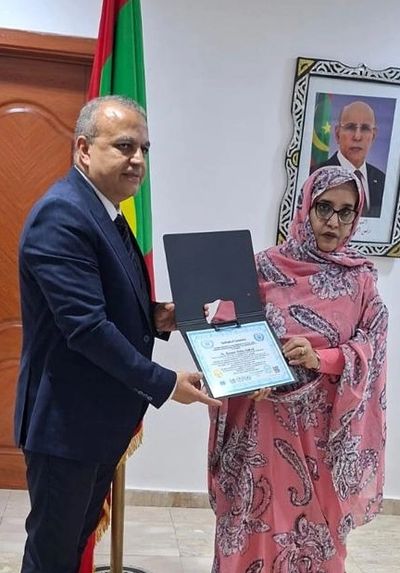
- Her Excellency Ms. Messouda Baham Mohamed Laghdaf, Minister of Environm trueent and Sustainable Development of the Islamic Republic of Mauritania, received a delegation of the rganizationheaded by Dr. Ayman Swidan, a member of the Association and Chairman of the Committee for Environmental Protection, Development, and Livestock Programs in the Maghreb Arab States, and Eng. Ibrahim Tahoun, a member of the Organization for Public Relations in the Maghreb Arab States, at the Ministry’s headquarters in the capital, Nouakchott, in the presence of a number of senior officials. The meeting discussed the efforts of the Mauritanian Ministry of Environment to promote sustainable environmental development, and reviewed areas of joint cooperation in the fields of environmental protection, adaptation to climate change, and support for environmental projects that serve the sustainable development goals in Mauritania.
- Ways to enhance international partnerships to secure technical and financial funding for vital environmental initiatives were also explored. The representative of the Organization expressed the Organization’s readiness to provide specialized technical cadres and expertise in the fields of environmental protection, in addition to assisting in applying for financial grants from the European Union and the European Commission for the benefit of the Ministry of Environment in the Islamic Republic of Mauritania, within the framework of supporting sustainable environmental development projects in accordance with the best international standards. The delegation also affirmed the Organization’s keenness to strengthen cooperation with the Ministry in future joint projects, with the aim of achieving positive environmental, social, and economic impacts that are consistent with the United Nations Sustainable Development Goals. At the conclusion of the meeting, Mr. Ayman Swidan, a member of the Organization, presented a Certificate of Appreciation to Her Excellency Ms. Messouda Baham Mohamed Laghd, in recognition of her exceptional efforts in the environmental approach, strengthening international cooperation, and supporting the path of sustainable environmental development in Mauritania.

Environmental Pollution – Formatted Version
In the next points, we will learn about the most important environmental pollutants and how we have helped to address them in Egypt, Libya, and Saudi Arabia, as well as pollution in the agricultural environment.
Many different definitions and concepts about environmental pollution have emerged, and the definitions have stabilized in formulating a clear concept of environmental pollution. Environmental pollution is defined as the addition of any substance—liquid, gaseous, or solid—or the addition of any form of energy such as heat, sound, and radiation to the environment. This occurs at rates that exceed their natural levels and the environment’s absorption capacity, causing various environmental problems known as pollution.
Environmental pollution is classified into three main categories:
- Water pollution
- Air pollution
- Land pollution
There are also secondary or subsidiary pollutants that fall under these three classifications, including:
- Noise pollution
- Radioactive pollution
- Plastic pollution
- Light pollution
Environmental Pollutants
Environmental pollution results from the presence of various harmful substances in the environment at levels exceeding its absorption capacity. Among the most well-known pollutants are:
- Methane compound: The main component of natural gas; its presence in certain compounds contributes to increased global warming.
- Carbon monoxide gas: Produced by various combustion processes, leading to air pollution and damage to the respiratory system.
- Chlorofluorocarbons (CFCs): Highly destructive to the ozone layer; used in some industrial applications and associated with cancer risks in humans.
- Nitrogen oxides and compounds: Extremely harmful compounds that, when combined with oxygen at high temperatures, cause severe air pollution.
- Plastic products: Widely used materials that cause serious environmental damage and are major contributors to water and marine pollution.
- Terrestrial ozone: Harmful to the environment; increases respiratory diseases and accelerates corrosion of paints and coatings.
- Mercury: A compound that severely pollutes water and air when used in industrial processes.
- Car exhaust: Emissions from fuel combustion that pollute the air and damage the respiratory system.
- Uranium: A major cause of radioactive contamination, used in nuclear industries.
- Volatile organic compounds (VOCs): Transform into harmful gases that pollute the air.
- Chemical fertilizers: Contribute to soil and water pollution.
- Waste dumps: Damage and contaminate soil.
Contributions to Treating Environmental Pollutants
We have contributed to addressing environmental pollutants through the preparation of various research studies aimed at identifying the best methods to manage and reduce pollution.
These studies have resulted in several solutions and treatment methods, including:
- Replacing conventional energy sources with clean and environmentally friendly alternatives.
- Using fuels free of sulfur and lead compounds.
- Correcting sources of air pollution to reduce emissions.
- Using raw materials that cause less environmental damage.
- Applying pollution control equipment to reduce pollution levels.
- Avoiding nuclear industries that produce large amounts of radioactive waste.
- Modifying industrial equipment to reduce resulting pollution.
- Maintaining gaseous pollutant control devices.
- Expanding plant cover to purify air and cleanse soil.
- Conducting further research on alternative energy sources and modern treatment technologies.
Individual Guidance and Community Contributions
We have guided and collaborated on individual actions that help reduce pollution, including:
- Using environmentally safe chemicals and paints.
- Recycling waste and reducing overall waste generation.
- Reducing fuel consumption and using public transportation instead of private vehicles.
- Limiting the use of gas- or fuel-powered equipment and shifting to renewable energy sources.
- Avoiding the burning of waste and residues to protect the atmosphere.
- Reducing wood consumption and preserving vegetation.
Solutions for Water Pollution
Water pollution is one of the main types of environmental pollution, with numerous causes and treatment methods. Solutions include:
- Preventing the disposal of human waste into water bodies.
- Treating industrial wastewater before discharge into rivers and seas.
- Reducing the use and disposal of canned food containers and plastic waste into seas and rivers.
- Limiting petroleum exploration activities in seas and oceans.
- Maintaining ships that transport petroleum and hazardous materials.
- Using filters and purification systems for sewage discharged into water.
Methods for Dealing with Air Pollution
Air pollution poses a significant threat to human health. Key mitigation methods include:
- Using equipment powered by solar and electric energy.
- Utilizing wind energy to generate electricity instead of diesel fuel.
- Expanding green areas to reduce carbon monoxide and increase oxygen levels.
- Strengthening oversight of factories and installing gas treatment plants and filters.
- Planting trees along roads to absorb harmful emissions.
Methods for Dealing with Soil Pollution
Soil pollution is the third major type of environmental pollution. Control measures include:
- Avoiding disposal of waste and residues on agricultural land.
- Preventing the dumping of non-degradable plastic materials into soil.
- Producing and using biodegradable products.
- Reducing the use of chemical fertilizers and pesticides.
- Avoiding excessive soil leveling that reduces fertility.
- Using appropriate water for irrigation to preserve soil quality.
- Raising agricultural awareness to protect soil fertility and essential minerals.
Addressing the Harm of Environmental Pollution to Humans
Environmental pollution has caused serious harm to living organisms, particularly humans. Since the human food chain includes animals, birds, and fish, pollution impacts human health directly and indirectly.
Major health impacts include:
- Respiratory, lung, and heart diseases, as well as respiratory cancers caused by air pollution.
- Various cancers affecting different parts of the body due to consumption of contaminated food containing harmful and radioactive substances.
- Acid rain resulting from air pollution, which contaminates soil and crops and harms human health.
- Air and water pollution that releases toxic gases, accelerates ozone layer depletion, and negatively affects life.
- Damage to animals and other living organisms due to polluted water and soil and consumption of contaminated resources.
Volunteer Opportunities
Join our team of dedicated volunteers and make a difference in the lives of those we serve. Whether it's serving meals at a homeless shelter or mentoring a child in need, there are many ways to get involved and give back.